
"What was GC2019 like?"
By Ben Roe
The venue where the Conference was held was intimidatingly vast. Imagine a football field surrounded by stands which can seat 82,624 people! Now imagine the field surrounded by a one-story wall, with the first level of spectators on top of that. The spectators were so far from the folks seated around 168 round tables on the main floor that without binoculars or a small telescope you couldn't see who was who in the possible 864 delegates from six continents, speaking over five languages.
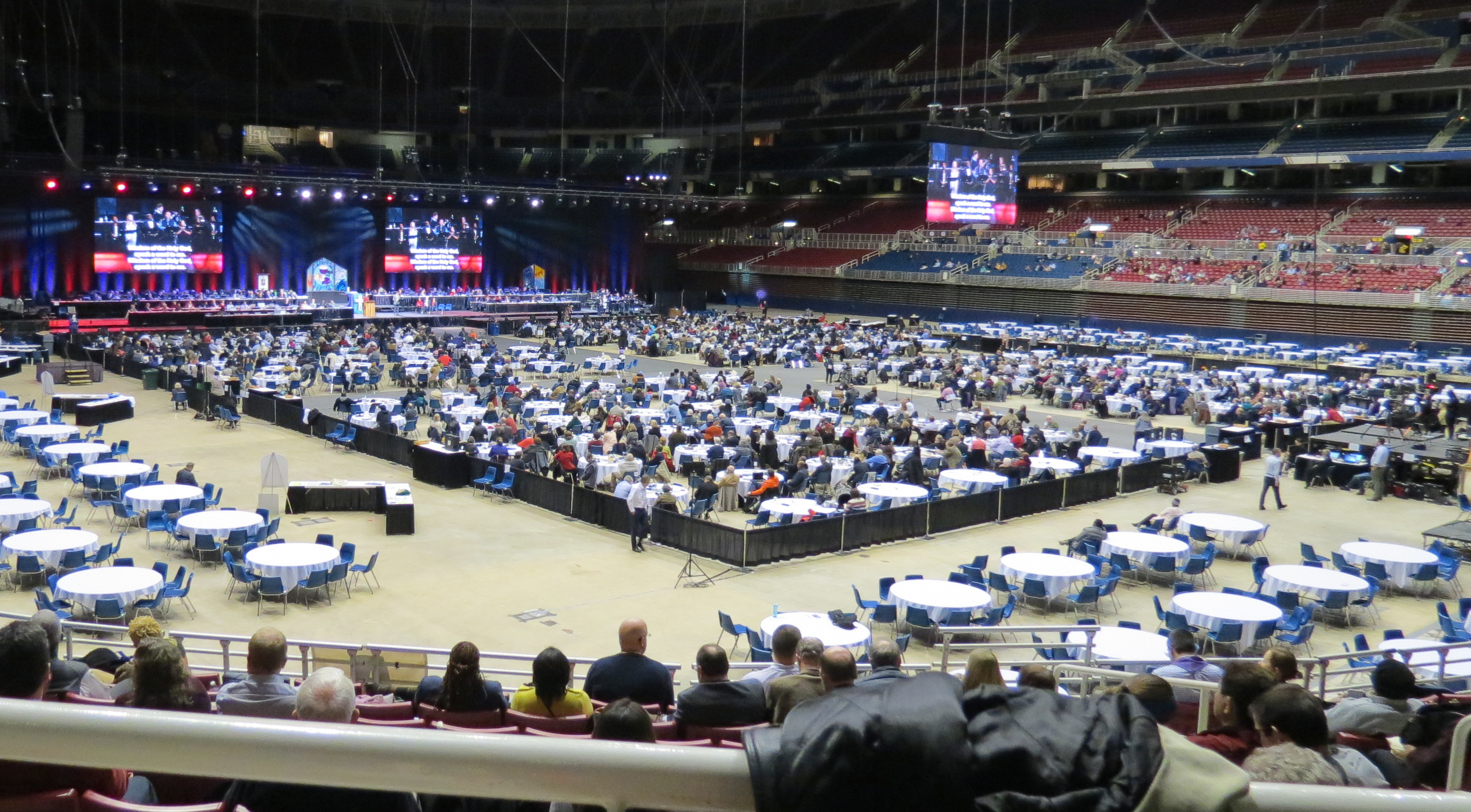
It was a field and an arena designed for security: you entered the building through security stations with metal detectors, where all bags were inspected.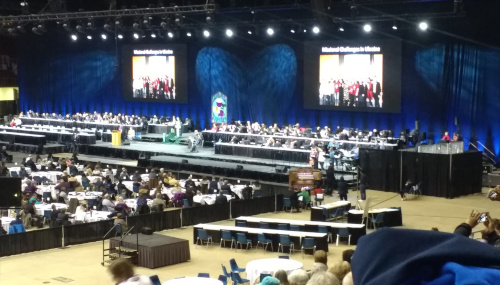 At the front of the meeting space was a very tall cloth curtain, dividing the space into a 60-yard main space and a 40-yard utility space (where translators were housed). The stage was set with multiple levels of chairs and tables where all the bishops were to sit. In front of them was the presider's table on one side and the musicians on the other, with a podium in the center.
There were giant video monitors which gave visibility to the delegates of who was speaking. The sound system was good, so everyone could be heard who spoke at microphones.
I am mobile in a scooter, and was surprised when volunteers at the venue on the first day didn't have a clue how to get me to the spectator's gallery. They later said they'd been asking for 3 days for those plans. That first day I was escorted on a circuitous route to an elevator which stopped on the right floor. After that, I decided to get a press credential (as an editor for WMJM communications and web site), and had a much easier time getting to the right place.
The task ahead of the bishops and delegates was to decide what to do about sexuality, and most specifically "homosexuality" (an out-moded term that science has rendered obsolete).
Just imagine a 864-member family dinner table discussing "homosexuality" with strongly held, diametrically-opposed opinions, each claiming the authority of God. And at the end of dinner, someone was going to win and someone was going to lose. That's the way Robert's Rules of Order is set up.
There were passionate speeches, many, many "points of order" which were supposed to keep watch over whether the rules were followed. Some were genuine, a few were more like speeches.
There were speeches pointing out the hypocrisy of singling out LGBTQI people when the scriptures speaking approvingly about polygamy (think King David) and against divorce and adultery are so much more clear. There were speeches saying we would be losing a whole generation of young people if the traditionalist plan passed. As well as a young adult who spoke for it.
By the end of the Conference, they had:
- adopted the flawed and at least partially unconstitutional Traditional(ist) Plan, 438-384 (53.28%);
- adopted a new and temporary way for churches to leave the denomination (which may be unconstitutional as well);
- adopted a timeline for GC2019 changes to be effective for Central Conferences: a year after 2020 GC;
- adopted recommendations to handle pensions for pastors and churches who leave the denomination;
- adopted a request for a declaratory decision by the Judicial Council on the constitutionality of the Traditional Plan.
The Judicial Council meets April 23-26 and will decide how much of what passed was constitutional. If the Traditional(ist) Plan is taken as a whole, which is how the chair ruled it had to be, then it will be unconstitutional. If it is taken in pieces, the most discriminatory parts will be unconstitutional, because they single out one group for special, punitive handling.
(Photos by Ben Roe)