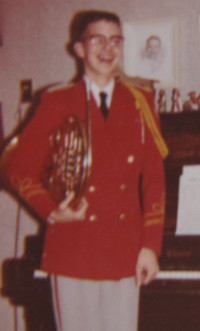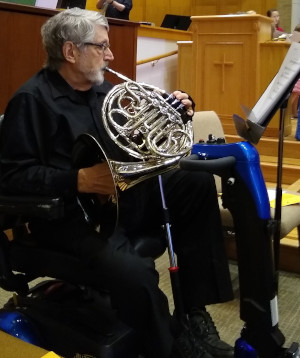
Music has been important in my life, from the earliest exposure to church music listening as I grew up as a very young child, through singing in grade school music classes, church and high school choirs, to learning first percussion in fifth grade and then beginning to learn the horn ("French Horn") in sixth grade. I played solos on horn for church and for music contests in high school. My sophomore, junior, and senior years I played first horn in the Nebraska Allstate Band and then Hastings College Honor Band.
I wrote this in my autobiographical memoir, A Boy Survives:
Music has been critically important in my life and survival. It was something that came somewhat naturally. In music was expressed profound emotions beyond any words: joy, tragedy, yearning, playfulness, freedom. Music was also an inspiration to me, from the great hymns of the church to the great symphonies. And by listening, singing, and playing, I could participate in soul-soaring, transcendent freedom. I could also establish for myself a sense of my competence in something that was truly mine. In high school, I developed a nightly schedule of listening to far-off classical radio concerts on such stations as WGN in Chicago, KSL in Salt Lake City, and occasionally WLW in Cincinnati. Music still lifts me out of myself and gives me perspective on what is happening inside me and around me. It is an important component of my survival mechanism.
In college at Nebraska Wesleyan, I played first chair horn in the orchestra and second horn in band until my last year or so. I was honored to play a solo in a concert one of my last years at Wesleyan. The recording is not great (mostly because of my old tape deck). It's in MP3 audio format here. As I recall, it was a piece by William Schumann.
In seminary, I played horn at the festivals of All Saints and Easter for several years, transposing from the hymnal as we accompanied the six or seven hymns sung during these high church services. These were a highlight of my time at Claremont School of Theology (called at the time, the School of Theology at Claremont).
At the first parish where I served as associate minister, I played a couple of solos at Fairbury United Methodist Church, after I bought an old single horn (from Czechoslavakia!) from a retired music teacher in the church. I used that horn until 2019 when I bought a Reynolds double horn (F and B-flat) from a minister who was moving across the country.
After we moved to Lincoln, I played one season in a community orchestra, which included concerts in Lincoln and a road trip to a nearby town in Nebraska.
After relocating to Denver, we became season ticket-holders to the Colorado Symphony. Then during Covid, we were invited to subscribe to the streaming Berlin Philharmonic, which we enjoy nearly nightly. After we discovered Arvada United Methodist Church in 2014, I played in the annual Christmas music concert and various instrumental groups, including accompanying a couple of cantatas.
In August, 2025, after months of soul-searching and increasing weakness in my shoulders and arms due to post-polio syndrome, I decided to sell my double horn and end my playing career. I had years of rich and meaningful playing, both fun and challenging, since 6th grade! But I decided it would be best for my body long term. My shoulders both seem to be decreasing in their strength and range of motion. I've torn part of my right bicep muscle and that is non-operable. My right shoulder, I'm told, has no functional "rotator cuff" musculature. Surgery in my post-polio context is not advisable given what would happen to my left arm and shoulder during the recuperation. So, I'm trying to "conserve to preserve," my new mantra for post-polio.
It's been hard, but I thought about it for months. It was a choice to stay as independent as I can for as long as I can, and my shoulders were now in a delicate balance as to how many transfers I could do in a day. The amount of time I hold the horn even on the holder I made, and the number of times I lift it to the holder, all contribute to what will eventually be enough "overuse" to cause further loss of strength.
As I've been reflecting about this loss, the emotional thing that I've noticed is that playing the horn, especially in the parts where its characteristic "heroic" sound stands out, horn allowed me to proclaim in a kind of symbolic way, "I survived!" (Thanks to the framing of my book title by a post-polio friend.) Examples of this include the use of the horn at the very end of Swan Lake in the recording I have from Andre Previn and the London Symphony, where the horns come in super loud with a sustained high note (I notice that other recordings don't emphasize this, sadly, IMHO). Another example is the final movements of Beethoven's 5th Symphony and Brahms 1st Symphony where the horns are heard in this kind of triumphant or forceful way. Richard Strauss's Don Juan is a classic, as well as many other places in classical music.